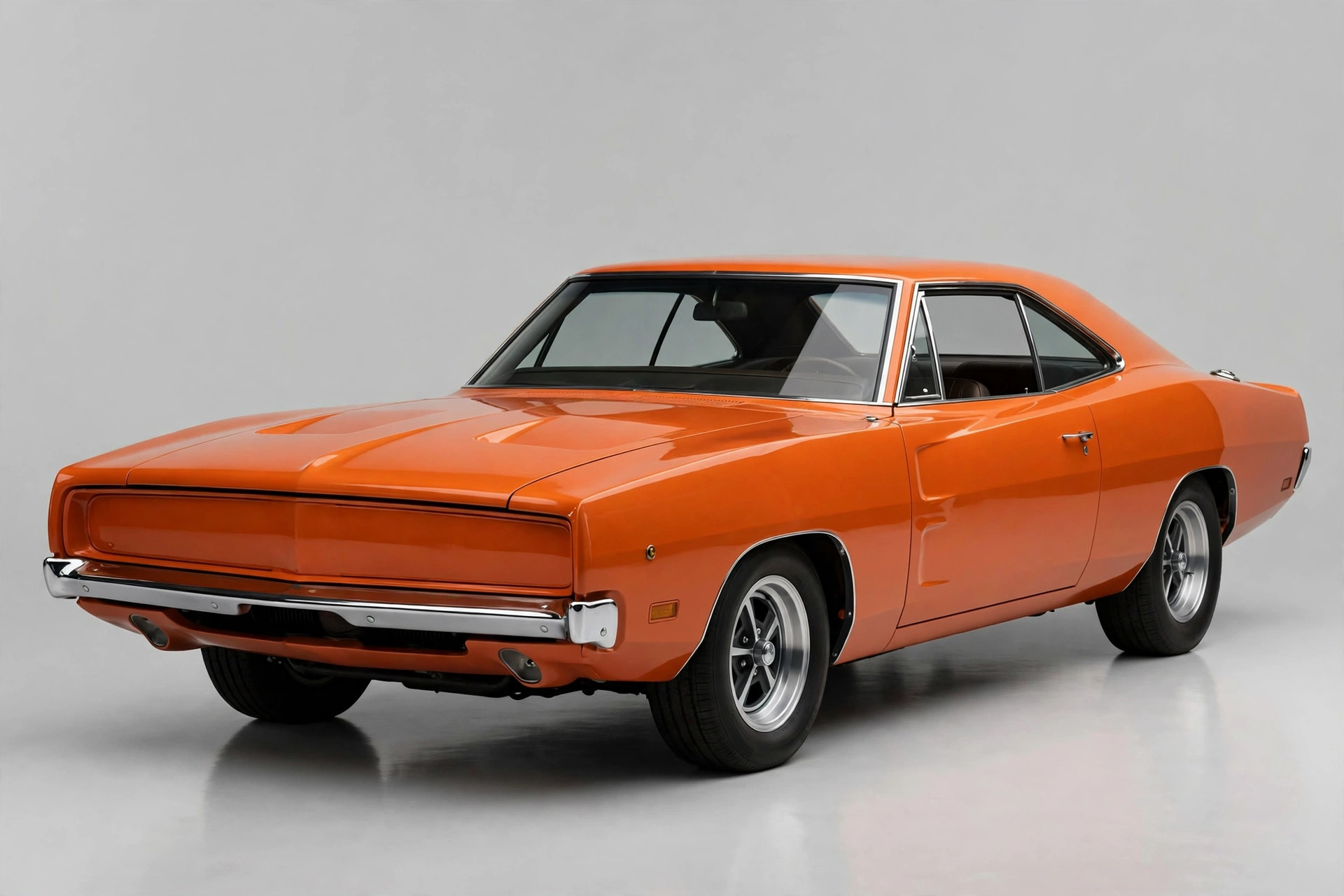
Some cars get old. The 1969 Dodge Charger refuses to. More than half a century on, it is still the shape people picture when they hear “muscle car” — long hood, Coke-bottle hips, hidden headlights, and a tail wide enough for a bumblebee stripe. This is not a road test — nobody here drove a new one in 1969. It is a look back at what Dodge built, what period sources recorded, and why this year still matters.
One note before the numbers: every horsepower figure below is Dodge’s factory gross rating — measured on a test stand, without accessories, exhaust, or emissions equipment. Gross ratings read higher than modern net figures, which is why the era’s numbers look so heroic — but they are the numbers Dodge published.
Engines and Specs
The 1969 Charger offered a simple menu: pick your V8, pick your gearbox, and decide how serious you were. The Road/Track (R/T) package was the performance flagship, standard with the 440 Magnum.
- 383 V8, 2-barrel: 290 hp / 390 lb-ft · 3-speed manual, 4-speed manual, or 3-speed TorqueFlite automatic
- 383 V8, 4-barrel (Charger-only in 1969): 330 hp / 425 lb-ft · 3-speed manual, 4-speed manual, or 3-speed TorqueFlite automatic
- 440 Magnum V8, 4-barrel (R/T standard): 375 hp / 480 lb-ft · 3-speed TorqueFlite automatic standard on R/T; 4-speed manual with Hurst shifter optional
- 426 Hemi V8, dual 4-barrel (optional): 425 hp / 490 lb-ft · 3-speed TorqueFlite automatic or 4-speed manual
Base cars started with a 318 V8 rated at 230 hp; a slant-six was available but found almost no buyers. Two cautions: the 440 Six Pack (390 hp) appears in some 1968–70 guides, but period documentation ties it most firmly to 1970 — treat any claimed 1969 Six Pack car skeptically. And the 383 Magnum (335 hp) in many listings did not appear in a Charger body until 1971; the 1969 Charger’s four-barrel 383 is the 330-hp version, unique to the Charger that year. Period tests of the Hemi-powered Charger 500 recorded 0–60 mph in 5.7 seconds and a quarter mile in 13.48 seconds at 109 mph — quick for 1969.
What Made It Special
The 1969 Charger was the second year of the second-generation body. The 1968 car had jumped from about 15,788 sales in 1967 to 96,100, and 1969 kept the momentum with around 89,000 cars built, including 20,057 R/Ts. Dodge changed just enough to identify the year at a glance: a grille with a center divider splitting the hidden-headlight face, long horizontal taillights replacing the 1968 car’s four round units — both designed by Harvey J. Winn — and a redrawn bumblebee stripe, one wide stripe framed by two narrow ones with an R/T cutout.
A new Special Edition (SE) trim added leather front-seat inserts, chrome rocker moldings, and woodgrain on the wheel and panel, combinable with the R/T as an R/T-SE. A sunroof joined the options list; only 260 buyers ordered one.
Then came the two cars that made 1969 a racing year: the Charger 500, built in a run of 392 street cars to homologate its flushed rear window and grille for NASCAR, and the Charger Daytona that followed — pointed nose, towering wing, 503 street cars built to satisfy the rulebook. Neither was a volume car, but both proved the Charger was no street poseur.
And then came television. The Dukes of Hazzard (1979–1985) put an orange 1969 Charger with “01” on its doors on screen every week, jumping over anything in its path, and the show bought hundreds of Chargers because stunt work destroyed them regularly. That is why non-car people recognize this car instantly. (The famous black Charger in the 1968 film Bullitt was a 1968 car, not a 1969.)
Good Stuff
- The shape has never dated. Coke-bottle body, flying-buttress roof, recessed rear window — it still stops traffic like few 1969 cars can.
- The R/T was a real performance package, not a sticker. Heavy-duty suspension and brakes, dual exhaust, and the 440 Magnum as standard.
- The engines are approachable to work on. Buyer guides note the 383 and 440 are straightforward, inexpensive engines to maintain; the Hemi is the exception that demands specialist care.
- It has genuine racing heritage. The 500 and Daytona were built for NASCAR, not for a brochure.
- Values have held up. Per the Hagerty Price Guide (July 2026), a 440 car ranges from about $57,000 in good condition to $115,000 in concours condition, while Hemi cars run from about $139,000 to $276,000.
Bad Stuff
- It drives like 1969. Brakes, steering, and ride comfort feel ancient next to any modern car — a weekend car, not a commuter.
- Rust is the enemy. The metal under the rear window is famously rust-prone, and repairs there must be fabricated rather than bolted on.
- Big-blocks drink fuel. Nobody buys a 440 or a Hemi for economy, but running costs still surprise first-time buyers.
- Hemi cars are priced out of reach for most. Fewer than 500 Hemi-powered Chargers were built in 1969, and their prices reflect that rarity.
- Clones and tributes are everywhere. General Lee replicas and R/T clones flood the market, so a car’s badges prove nothing on their own.
Should You Buy One Today?
Yes, if you want the icon rather than the investment. The sweet spot is a 440-powered R/T: the car most enthusiasts actually wanted in 1969, far more findable than a Hemi, with a value range that leaves room for a good driver rather than a trailer queen. A Hemi car is a collector purchase, not a first classic — budget for specialist maintenance on top of the price.
Before paying, check three things: rust, especially around the rear window and frame rails; documentation — for 1969 and 1970 cars, body stampings should match the VIN, your best defense against a re-badged clone; and drivetrain originality, since a numbers-matching 440 car commands serious money precisely because so many lost their original engines. Buy the best-documented car you can afford, not the cheapest orange one you can find.
The Charger name is still going — in a very different form. Today’s Charger runs on six cylinders and electricity, and a supercharged V8 return is reported for 2028 (see our Charger Hellcat article). The 1969 car is why that name still means anything. For every other car on the way, see our Future Cars hub.
Frequently Asked Questions
How do I tell a 1969 Charger from a 1968?
Two details give it away: the 1969 grille has a center divider splitting the hidden-headlight face, and its taillights are long horizontal lamps, not the 1968 car’s four round units.
Was the General Lee a real factory trim?
No. It was a standard 1969 Charger dressed for television — orange paint, “01” doors, and doors welded shut on the show so the actors climbed through the windows. Any “General Lee edition” for sale today is a tribute, not a factory model.
What is the most important thing to check before buying?
Rust and paperwork, in that order. Inspect the metal under the rear window and frame rails, then verify the body stampings match the VIN and the drivetrain is the one the car left the factory with.

Arsalan Shaikh is the founder and editor of CarModels.online. A lifelong car enthusiast, he writes practical, jargon-free buying guides to help readers choose the right car with confidence — from first-time buyers to seasoned owners.