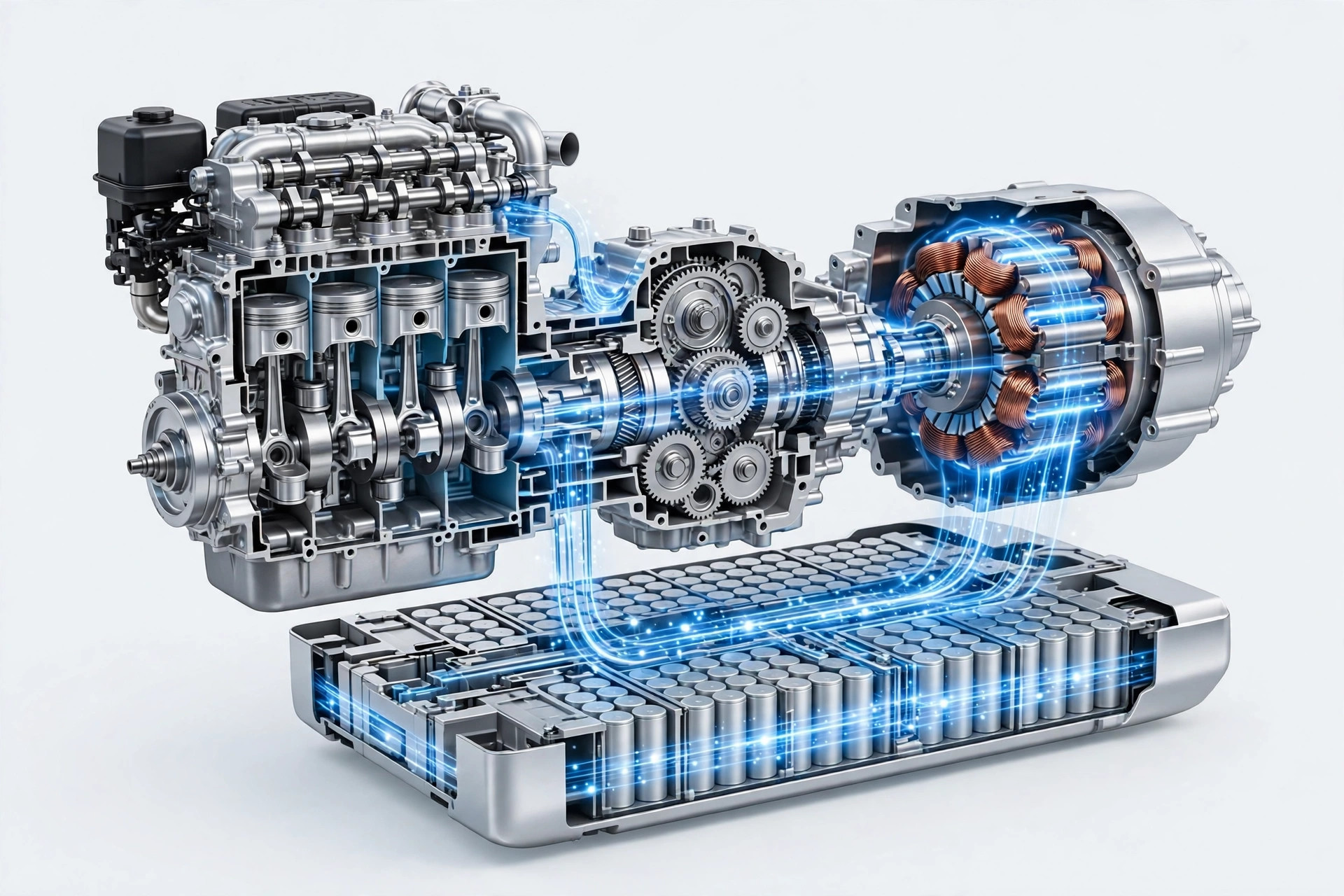
Walk any dealership lot in America today and half the badges say “hybrid.” The stickers mention motors, batteries, regenerative braking and e-CVTs, but rarely explain them. A hybrid is neither an electric car with a gas engine as backup nor a gas car with an occasional motor push. It is a system in which two power sources share one job, and the clever part is how they divide it.
What Are the Parts of a Hybrid Powertrain?
Every full hybrid has the same four ingredients. A gasoline engine, usually a smaller one. One or more electric motors that can both drive the wheels and generate electricity — the same machine, in opposite directions. A small high-voltage battery that stores electricity for the motors. And power electronics deciding, many times a second, where power should come from and go. Hybrids differ in how those parts are connected. There are three main ways.
How Does a Series Hybrid Work?
In a series hybrid, the gasoline engine never touches the wheels. It has one job: spin a generator that makes electricity. That electricity charges the battery or feeds the drive motor directly, and the motor alone turns the wheels. Think of the engine as an onboard power station: never matching road speed, it runs at its most efficient speed, then shuts off. Honda’s two-motor system works this way most of the time around town. The trade-off is conversion losses — turning gasoline into electricity and back into motion wastes some energy — so series systems usually hand direct control to the engine at steady highway speeds.
How Does a Parallel Hybrid Work?
In a parallel hybrid, the engine and the motor both connect to the wheels and can drive them together or separately. The motor adds torque when pulling away or accelerating; the engine takes over for cruising. Many Hyundai and Kia hybrids work this way, with a conventional-style automatic transmission. Mild hybrids are the lightest version: a small 48-volt motor assists the engine and recovers a little braking energy, but cannot drive the car alone. If a car can never move under electric power by itself, it is a mild hybrid, not a full one.
How Does a Power-Split Hybrid Work?
The third design, the power-split or series-parallel hybrid, is the most sophisticated — and the most common. At its heart is a planetary gearset, a compact set of sun, planet and ring gears linking engine, generator and drive motor. The system constantly splits engine power: some goes straight to the wheels, some spins the generator to charge the battery or feed the motor, so it acts as a series hybrid one moment and a parallel hybrid the next. It also replaces a conventional transmission — Toyota calls the result an e-CVT, because varying the generator’s speed changes the gear ratio smoothly, with no belts or stepped gears, keeping the engine in its most efficient range far more of the time.
What Does the Battery Actually Do?
First, drop a misconception: a conventional hybrid’s battery is not a fuel tank. It is a buffer — small, constantly filling and emptying, catching energy and handing it back seconds later. It charges itself from the engine and from braking, so you never plug the car in. That is why hybrid batteries are a fraction of an EV’s size: they only smooth out the moments when the engine would be least efficient — pulling away, crawling in traffic, waiting at lights. The engine still supplies most of the energy on a long trip; the battery’s job is to waste as little of it as possible.
What Is Regenerative Braking?
Regenerative braking is simpler than it sounds. In an ordinary car, braking turns forward motion into heat in the brake pads — energy gone forever. In a hybrid, lifting off the accelerator or pressing the brake tells the drive motor to run in reverse — as a generator. The wheels, still turning from momentum, spin the motor, converting that motion back into electricity for the battery. The resistance of generating is itself what slows the car, so the motor does part of the braking work. Friction brakes still take over for hard stops; regeneration recovers the energy gentle, everyday slowing would otherwise throw away as heat. It also works coasting downhill — one reason hybrid brake pads tend to last longer.
Why Do Hybrids Save More Fuel in Town Than on the Highway?
Around town, a gasoline engine is at its worst: idling at lights, revving away from stops, braking every block. A hybrid attacks all three: engine off at standstill, electric pull-away, braking energy recovered. On a steady highway cruise, those advantages mostly disappear: little braking to recover, no idling to eliminate, the engine already in a comfortable range. Hybrids still help on the highway, but the gap over a gasoline car is biggest in the city and narrowest at a constant 65 mph. For scale, the 2025 Prius LE is EPA-rated at 57 mpg city and 56 mpg highway — a car so efficient overall that the two numbers nearly meet.
Hybrid vs Plug-in Hybrid vs EV — What’s the Difference?
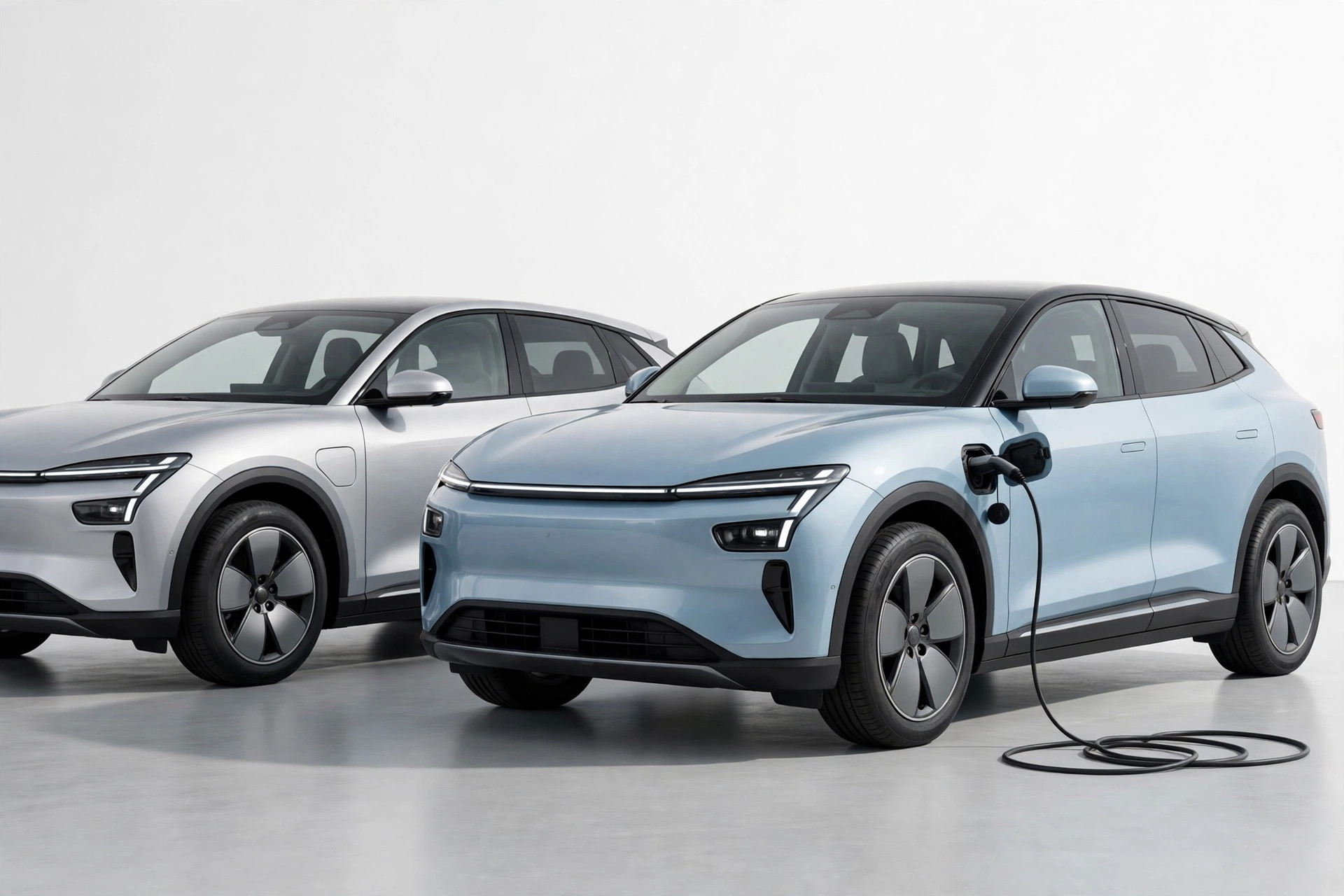
A conventional hybrid never plugs in, and its electric-only range is short — parking lots and slow traffic, not a commute. A plug-in hybrid (PHEV) adds a much larger battery you charge from a wall outlet, giving real electric-only driving for a daily commute before behaving like a regular hybrid on longer trips. A battery-electric vehicle (EV) has no engine at all, running entirely on its large battery. PHEVs use the same three layouts, just with a bigger battery and a plug — but the buying math is a different question, covered in our Hybrid vs Plug-in Hybrid vs EV: Real Running Costs Explained comparison.
Which Hybrid Type Suits You?
The architecture on the spec sheet matters less than how you drive. City traffic and short trips? Any full hybrid will transform your fuel bills — that is where electric running and regen do their best work. Mostly steady highway cruising? Compare highway ratings closely; a power-split or Honda-style two-motor system hands the engine direct control exactly there. Home charging and a short commute? A plug-in hybrid lets most daily miles run on electricity while the engine stays for road trips. Mazda’s upcoming 2027 CX-5 Hybrid debuts its own in-house hybrid system rather than borrowed Toyota hardware. Before you buy, run your numbers with our fuel calculator — your mileage and city-to-highway mix decide what a hybrid actually saves you.
Frequently Asked Questions
Do I need to plug in a hybrid?
No — a conventional hybrid charges its own battery from the engine and from regenerative braking. Only plug-in hybrids and EVs need a charger.
Can a hybrid drive on electricity alone?
A full hybrid can, for short distances at low speeds. A mild hybrid cannot; its motor only assists. A plug-in hybrid can go much further because its battery is far larger.
Does the hybrid battery wear out?
Like any battery it degrades slowly, but hybrid batteries live in a narrow, managed charge range rather than deep cycles. Check the hybrid battery warranty — it is usually longer than the basic warranty.

Arsalan Shaikh is the founder and editor of CarModels.online. A lifelong car enthusiast, he writes practical, jargon-free buying guides to help readers choose the right car with confidence — from first-time buyers to seasoned owners.