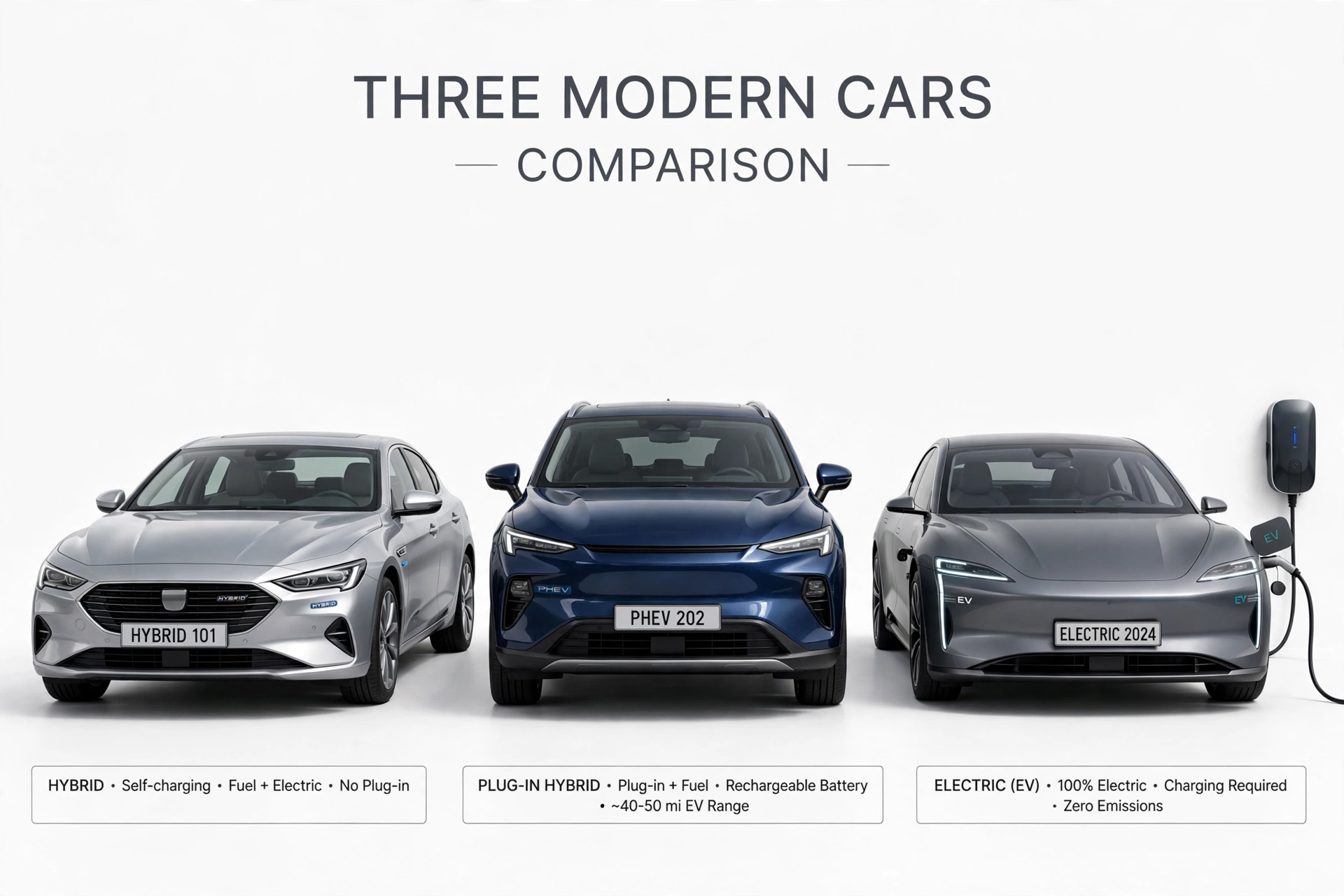
Hybrid vs Plug-in Hybrid vs EV: The Electrified Alphabet Soup
Walk into any dealership today and you will face a new vocabulary test: hybrid, plug-in hybrid, battery electric, mild hybrid, range extender. For most American buyers, the hybrid vs plug-in hybrid vs EV choice narrows to three main options. A conventional hybrid pairs a gasoline engine with a small battery and electric motor. A plug-in hybrid adds a bigger battery you charge from the wall for meaningful all-electric driving. A full battery-electric vehicle ditches the gas engine entirely. Each has real strengths and real compromises, and the right answer depends less on ideology and more on how you actually drive.
How Each Powertrain Actually Works
The Conventional Hybrid
A regular hybrid is the simplest step into electrification. Its small battery charges itself through regenerative braking and the gas engine, so you never plug it in. The electric motor assists the engine at low speeds and recaptures energy when you slow down, which is why hybrids shine brightest in city traffic. You fuel it exactly like a normal car, at any gas station, with no change to your routine.
The Plug-in Hybrid
A plug-in hybrid, or PHEV, works like a hybrid with a much larger battery that you charge at home or at public chargers. A full charge typically covers a typical daily commute on electricity alone, after which the car behaves like a regular hybrid. Think of it as an EV for your weekday driving and a gasoline car for your weekend road trips, with no range anxiety either way.
The Battery-Electric Vehicle
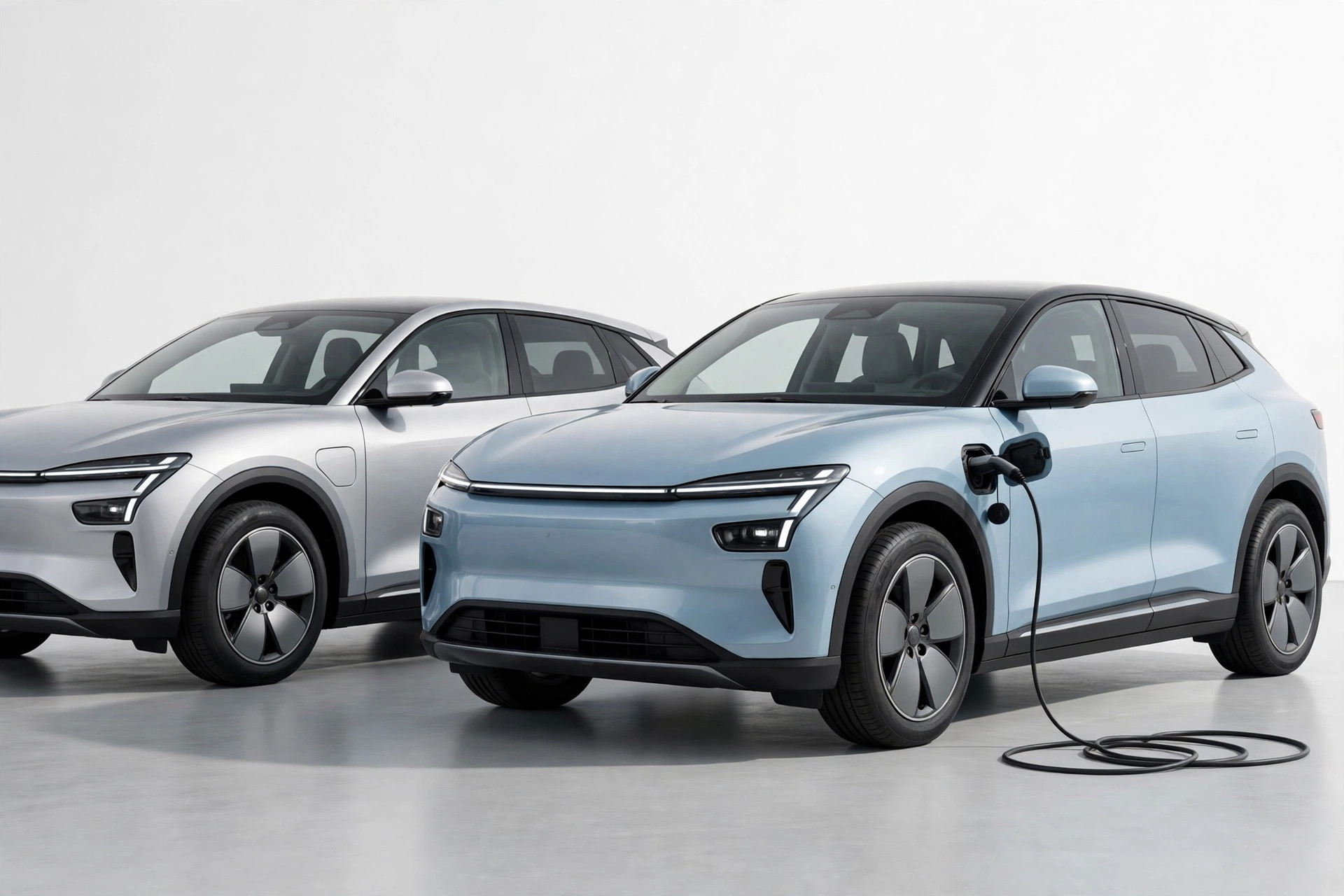
An EV runs purely on electricity stored in a large battery pack. There is no gas engine, no exhaust, and no oil changes. You charge at home overnight or at fast-charging stations on longer trips. The driving experience is defined by instant, silent torque and a low center of gravity that makes even tall crossovers feel planted.
The Purchase Price Picture
Upfront, conventional hybrids usually cost only modestly more than their gasoline equivalents, and the fuel savings can pay back the difference within a few years of normal driving. Plug-in hybrids cost more because of their larger batteries, so the math depends on how much driving you cover on electricity. Full EVs have grown more affordable as battery costs fall, and many now rival gasoline models in the same segment once incentives are factored in. Do not judge by sticker price alone: total cost over five or six years of ownership is where the powertrains diverge.
Fuel and Charging Math for US Drivers
This is where electrification earns its keep. A hybrid can cut your gasoline consumption substantially compared with a conventional car, with the biggest savings in urban driving where the electric motor does the most work. A plug-in hybrid driven mostly on electric power can slash fuel stops to a rare event; drivers with short commutes sometimes go months between fill-ups. An EV eliminates gasoline entirely, and charging at home on a standard residential electricity rate typically costs a fraction per mile of buying gasoline. Public fast charging costs more, but most EV owners do the vast majority of their charging at home. The savings scale with how much you drive: high-mileage commuters see the biggest payoff from plugging in, while low-mileage drivers may find the fuel savings alone do not justify a big upfront premium.
Home-Charging Reality Check
For plug-in hybrids and EVs, your home setup matters enormously. Most plug-in hybrids can fully recharge overnight from a regular household outlet, making them wonderfully easy to live with. Full EVs benefit greatly from a dedicated home charger, which fills the battery overnight and wakes you to a full charge every morning. Renters and apartment dwellers face a tougher equation: without reliable overnight charging, an EV means depending on public chargers, which is workable but less convenient. Before buying any plug-in vehicle, honestly assess your parking situation. A garage or driveway with access to power makes ownership nearly effortless; street parking with no charging access is a genuine obstacle worth taking seriously.
Maintenance: Fewer Moving Parts, Fewer Bills
Hybrids still need oil changes and engine service, but brake pads last far longer thanks to regenerative braking, and the powertrain has proven remarkably durable in taxi and fleet service. Plug-in hybrids share that advantage, though their dual powertrains mean slightly more complexity. Full EVs are the maintenance champions: no oil changes, no spark plugs, no transmission fluid, no exhaust system. Tires and cabin filters become the main recurring costs. One caveat: high-voltage repairs outside warranty can be expensive, so understand battery and powertrain warranty coverage before buying.
Incentives: Free Money, With Fine Print
Federal and state incentive programs exist to make plug-in vehicles more affordable, and they can meaningfully change the math. Federal tax credits may apply to qualifying new and used plug-ins, while many states add rebates, credits, or perks like carpool-lane access. The catch is that these programs come with eligibility rules around vehicle price, assembly location, battery sourcing, and buyer income, and the rules change frequently. Treat incentives as a bonus, and verify current eligibility for your specific vehicle before counting on the savings.
Resale Value Considerations
Resale is the wild card. Conventional hybrids from reputable brands have historically held value well on strong demand and proven reliability. Plug-in hybrids occupy a middle ground, appealing to used buyers who want electric commuting without charging anxiety. Full EVs have seen more volatile resale values as new models improve, battery prices fall, and incentive rules shift. That said, EVs with strong range, desirable brands, and healthy battery warranties tend to hold up better. If you plan to sell within a few years, a hybrid is the safest bet for retained value; long-term keepers can worry less.
Which One Fits Your Life?
City Commuters
For mostly short urban trips with home charging access, a full EV is hard to beat: minimal per-mile costs and quiet, instant torque perfect for stop-and-go traffic. A plug-in hybrid is the fallback if charging access is uncertain.
Suburban Families
For the suburban mix of school runs, errands, and weekend activities, a plug-in hybrid hits the sweet spot: daily driving on cheap electricity, gas engine ready for longer trips. A conventional hybrid is the simpler alternative with excellent fuel economy.
Road-Trippers
For regular long highway trips through areas with sparse charging, a conventional hybrid is the pragmatic champion: great highway economy, five-minute refueling anywhere, no planning required.
The Bottom Line
Conventional hybrids offer the easiest transition with proven savings, plug-in hybrids deliver the best of both worlds for home chargers, and full EVs reward with the lowest running costs. Match the powertrain to your mileage and parking, and you will not go wrong.
Our Verdict
There is no single winner — the right powertrain is the one that matches your charging access and your trip mix. Get those two answers right and the running costs take care of themselves.
Our Pick of the Range
For the widest range of American buyers, the plug-in hybrid is our pick: daily miles on cheap electricity, a gas engine for everything else, and no range anxiety on road trips — provided you can charge at home. If home charging is not an option, the conventional hybrid is the pick instead: proven savings with zero lifestyle change. A full EV is the pick for city commuters with reliable charging who want the lowest per-mile costs.
Frequently Asked Questions
Can I own a plug-in hybrid without home charging?
You can, but much of the point disappears — without regular charging it mostly behaves like a heavier conventional hybrid. If you cannot charge at home or work, buy the conventional hybrid instead.
Is a conventional hybrid still worth it as EVs keep getting cheaper?
Yes, for drivers without reliable charging or with frequent long highway trips through sparse-charging areas. Five-minute refueling anywhere is still a real advantage, and hybrid fuel economy in town is excellent.
How do I calculate my real fuel or charging cost?
Take your actual weekly miles, split them into city and highway, and price them at your local gas and electricity rates — our fuel calculator does exactly that. If you want the technology explained first, read our How Does a Hybrid Powertrain Work? guide.

Arsalan Shaikh is the founder and editor of CarModels.online. A lifelong car enthusiast, he writes practical, jargon-free buying guides to help readers choose the right car with confidence — from first-time buyers to seasoned owners.